D&O Insurance for Senior Living Boards: The Limit Is Shared, the Risk Is Personal

Ask a senior living board member what keeps them up at night and most will name a resident incident. Ask what their directors and officers policy actually says, and the room goes quiet.
That gap matters more in 2026 than it used to. The D&O market for nonprofits is stable on the surface. Gallagher’s 2026 benchmarking, reported by Business Insurance, found 40 percent of nonprofit D&O policyholders took a premium increase at renewal, 36 percent renewed flat, and 23 percent saw a decrease. The average increase fell to 1.8 percent, down from 2.4 percent in 2025. Lockton’s October 2026 executive risk update puts private and nonprofit D&O at flat to up 5 percent for the coming quarter, with employment practices liability at flat to up 10 percent.
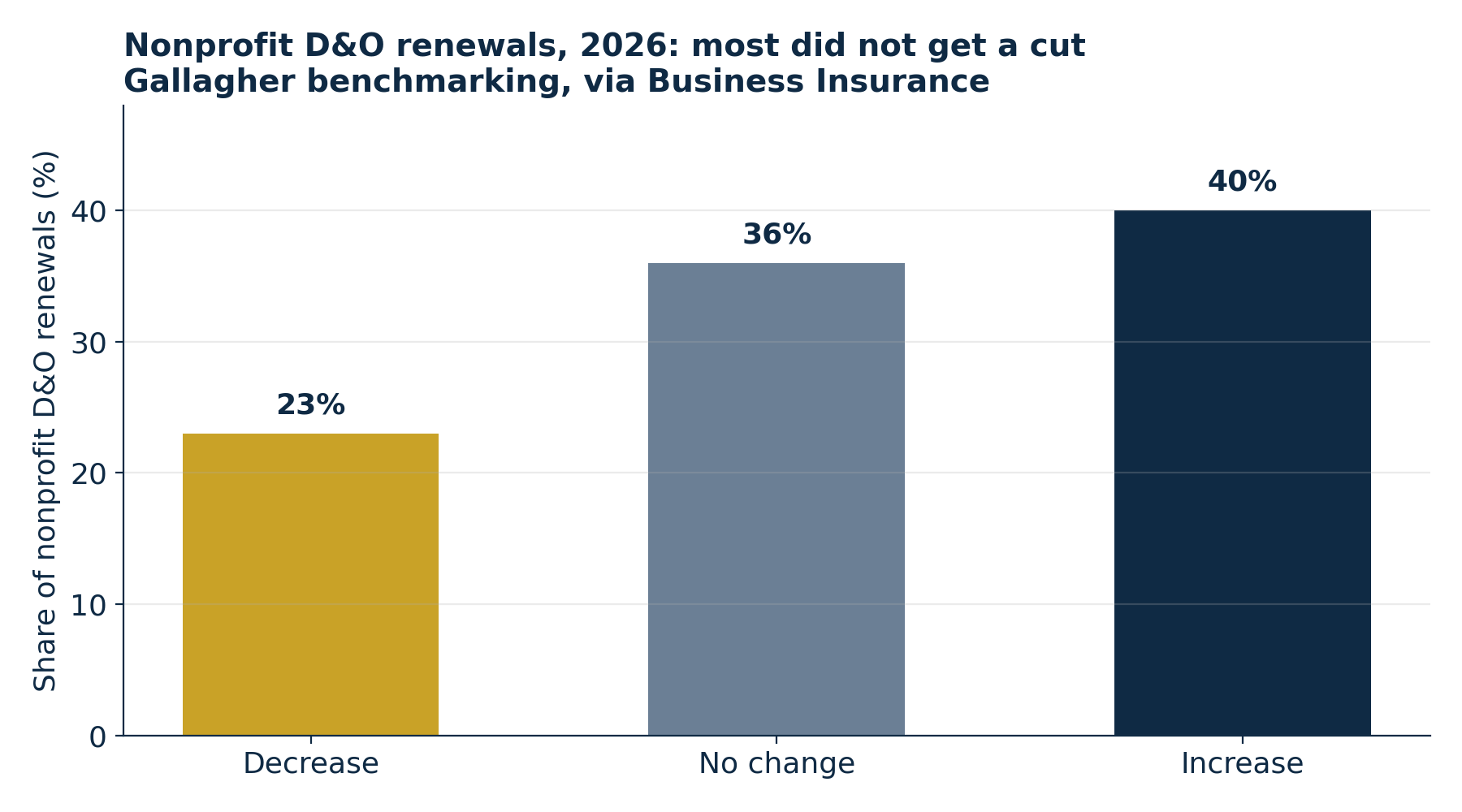
Stable price is not the same as adequate coverage. Gallagher also found D&O buying concentrated in lower limits, typically $1 million to $2 million for nonprofits with revenue up to $5 million, and $2 million to $3 million for revenue between $5 million and $15 million. Many senior living operators run well past $15 million in revenue on a single community. A limit chosen when the company was smaller can sit unchanged for years while the balance sheet, the census, and the claim environment grow around it.
What a board actually gets sued for in senior living
D&O claims in this sector rarely look like a securities case. They look like the business itself, read back by someone who lost money or lost a parent:
- Financial distress and bankruptcy. Creditors, trustees, and committees pursue directors over transfers between entities, related party deals, and decisions made while the company was sliding.
- Employment decisions. A terminated executive director or administrator alleges wrongful termination, discrimination, or retaliation and names the individuals who voted. This is why employment practices coverage, and whether it shares the D&O limit, matters as much as the D&O limit itself.
- Regulatory and licensure fights. Investigations and enforcement actions name the entity and, often, the people who governed it.
- Family and resident disputes that escalate past care. A claim that starts as a care dispute can add governance allegations when the family believes the board knew about staffing or safety problems and funded other priorities instead.
- Sale, merger, and closure decisions. Who was told what, when the board knew a building was failing, and how proceeds and obligations were handled between entities.
The Guardian Elder Care case shows the shape. In that Pennsylvania nursing home bankruptcy, the creditors committee pursued the company’s directors and officers, alleging improper transfers from HUD financed entities to non-HUD entities, disregard of corporate separateness, and breaches of fiduciary duty. The matter settled in early 2026 for $1.05 million paid into a designated estate account, with the D&O carrier, Starr Indemnity, at the table. No care claim drove that number. Governance did.
“A D&O policy is not bought for the years the census is full. It is bought for the year a committee, a regulator, or a fired executive reads the board minutes.”

Side A, Side B, Side C: three jobs, one limit
Most operators carry one D&O policy with three insuring agreements sharing a single aggregate limit:
| Part | Who it pays | When it responds |
|---|---|---|
| Side A | The individual director or officer, directly | When the company cannot indemnify them, is legally barred from doing so, or will not, most often in insolvency or a derivative claim. |
| Side B | The company | Reimburses the company after it indemnifies its directors and officers, subject to the retention. |
| Side C | The company itself | When the entity is named in the claim alongside its leaders. |
Read that table as a budget problem. Defense costs usually erode the same limit. One serious claim does not send three checks from three buckets. It draws one bucket down, in this order of pain:
| Illustrative claim on a shared $1M limit | Defense | Settlement | Limit left |
|---|---|---|---|
| Employment claim, resolved early | $150,000 | $0 | $850,000 |
| Employment claim, settled after discovery | $150,000 | $400,000 | $450,000 |
| Governance claim, fully fought | $600,000 | $400,000 | $0 |
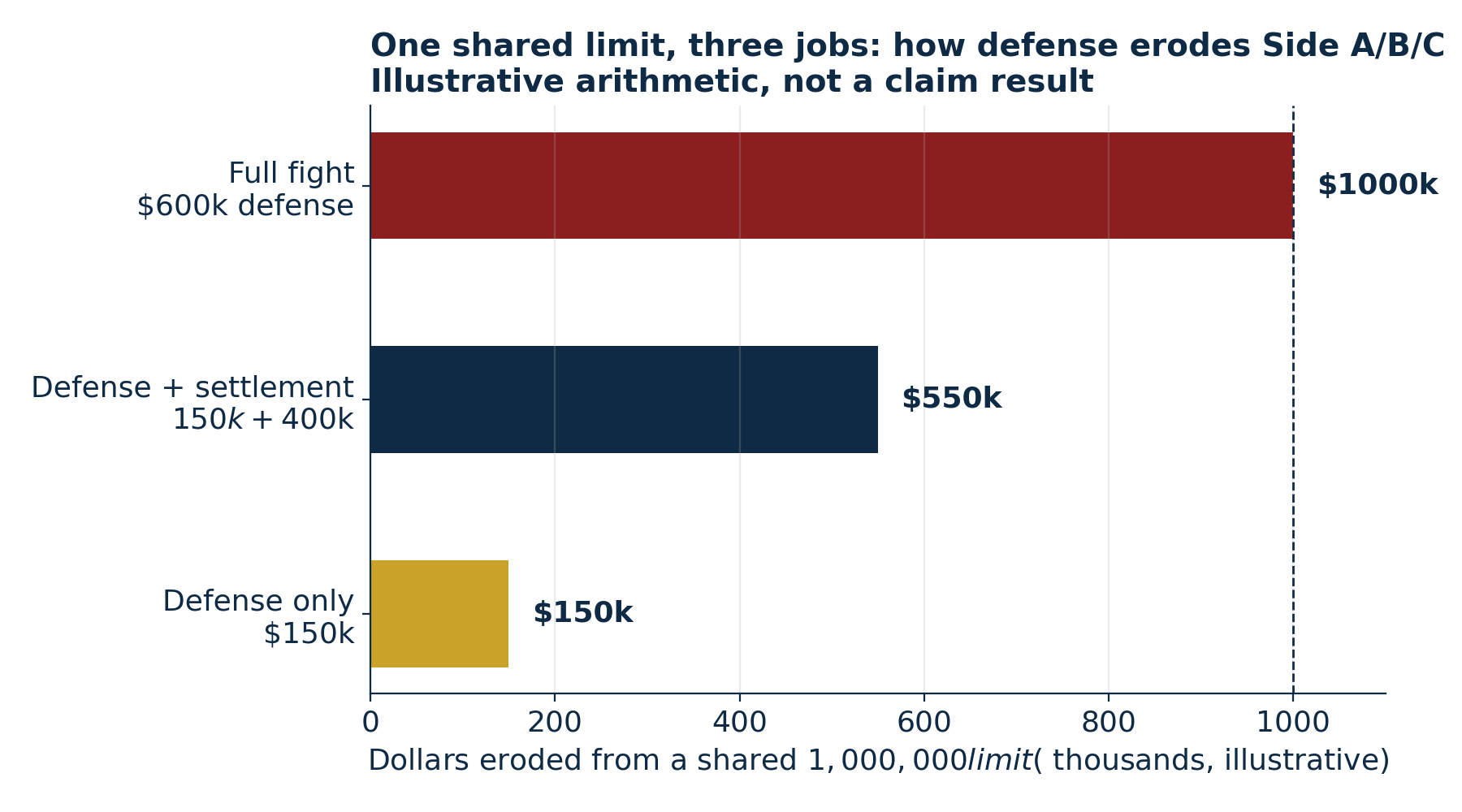
Illustrative arithmetic only. Actual defense costs, retentions, and whether defense erodes the limit depend on the policy form.
The third row is the board member’s real question. When the shared limit is gone, and the company is insolvent, what stands between the claim and a director’s house? That is Side A, and it is why sophisticated boards ask about a dedicated Side A layer, often written as difference in conditions coverage, with its own limit the entity cannot erode. It costs a fraction of the primary program. It only matters on the worst day the board will ever have, which is exactly the day it is for.
The traps we see in senior living programs
The limit was set for a smaller company
Limits bought at $1 million or $2 million for a single building get renewed by habit across a portfolio. Gallagher’s own benchmarks show most nonprofit buying clustered at the low end. Match the limit to current revenue, current entities, and current debt, not to the year the policy was first placed.
Employment practices shares the limit, quietly
On many management liability forms, employment practices coverage sits inside the same aggregate as D&O. Employment claims are the most frequent management liability claim a senior living operator will see, given hundreds of employees per building and constant turnover in leadership roles. One administrator termination can consume limit the board assumed was reserved for governance claims. Ask whether employment practices has its own limit, and price both ways.
The entity list does not match the org chart
Senior living structures are layered: operating companies, real estate entities, management companies, HUD financed borrowers, foundations. A claim names the entities it names. If a subsidiary, a management company, or a newly acquired building is not scheduled or not within the policy’s definition of a subsidiary, the coverage argument starts on day one. Guardian turned in part on transfers between entities. The policy has to recognize the same structure the plaintiff will draw.
Claims-made means the tail is the coverage
D&O is written on a claims-made basis. The policy that responds is the one in force when the claim is made, not when the decision was taken. A sale, a closure, a carrier switch, or a non-renewal without an extended reporting period can leave former directors exposed for decisions made years earlier. Any transaction, wind down, or program move needs the tail priced before signing, not after.
Retentions and healthcare scrutiny are rising where it hurts
Gallagher notes large healthcare accounts are seeing reduced insurer capacity and higher retentions even while the broader nonprofit market stays stable. Senior living sits inside that healthcare scrutiny. Expect underwriters to read audited financials, debt covenants, survey history, and litigation history before quoting, and expect a financially stressed operator to pay more, retain more, or both, at exactly the moment its board most needs the coverage.
Five questions for the next renewal
- What is our total limit, and how much of it would one employment claim consume before a governance claim ever arrived?
- Is Side A protected by a dedicated layer, or does it share one eroding limit with the entity?
- Does the entity schedule match our current org chart, including management companies, real estate entities, and every community acquired or sold since last renewal?
- What retention would we owe on an employment claim versus a governance claim, and can the operating account actually fund it this quarter?
- If we sold, closed, or restructured a building tomorrow, what tail coverage do our current and former directors have, and what does it cost to extend it?
None of these questions requires a lawyer to ask. All of them are cheaper to ask in a renewal meeting than in a deposition.
The bottom line
D&O is the one line in a senior living program where the insured is a person, not a building or a balance sheet. Prices are stable, capacity is adequate for clean risks, and the market data says most boards will renew this year without drama. That is precisely why this is the year to fix the structure: confirm the limit fits the company as it exists now, separate what can be separated, protect Side A, and make the entity list match reality. The claim that tests this policy will not ask whether the premium was competitive. It will ask what is left, and whose name is on it.
This article is general information about how directors and officers coverage is commonly structured. It is not legal or coverage advice. Policy language controls, and operators should review their own forms with their broker and counsel.
Sources
- Business Insurance, nonprofit D&O pricing remains stable, Gallagher 2026 benchmarking: https://www.businessinsurance.com/nonprofit-do-pricing-remains-stable-gallagher/
- Lockton Market Update, Executive Risk, October 2026: https://insights.lockton.com/lockton-market-update/oct-2026/executive-risk
- Arthur J. Gallagher & Co., 2026 Nonprofit D&O, Executive and Financial Risk Report: https://www.ajg.com/news-and-insights/nonprofit-do-executive-and-financial-risk-report-2026/
- Guardian Elder Care bankruptcy case summary, directors and officers settlement of $1.05 million approved February 17, 2026: https://elevenflo.com/cases/guardian-elder-care-at-johnstown-llc-d-b-a-richland-2580/