Grade your current broker.
Most operators never grade their broker until something goes wrong. This takes about three minutes.
- For senior living operators.
- You get a scored card: a total out of 100, a letter grade, and the weak sections circled.
- Left ungraded, it shows up as a renewal that lands as a surprise, a claim nobody fights, a call that does not get returned.
What happens to your answers. Echo Assurance stores them, and uses them to respond only if you leave your email. They are never sold. Your current broker is never contacted and never named. No sign up, and nothing to fill in before you start.
1. Responsiveness
Scored 4 or below. This section will be circled on your card.
Three optional questions
These help us read your card. They never change your score, and you can skip them.
Your broker’s grade
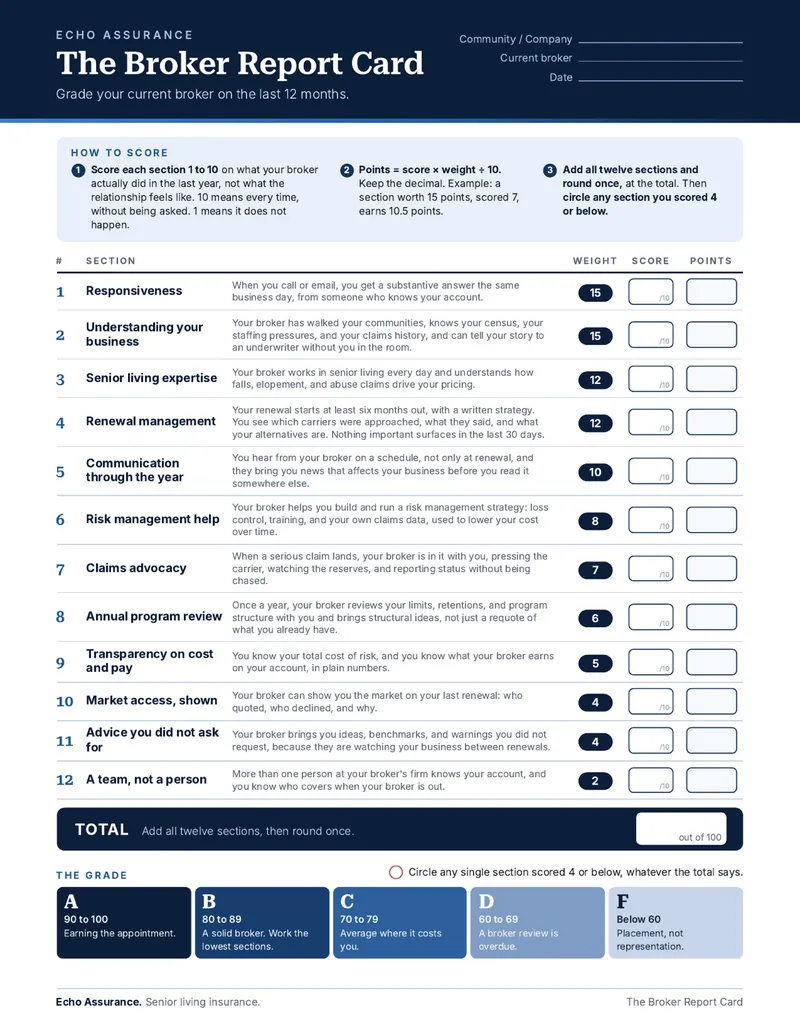
The Broker Report Card
Grade your current broker on the last 12 months.
| # | Section | Score | Points | Possible |
|---|---|---|---|---|
| TOTAL Add all twelve sections, then round once. | 0 out of 100 | |||
- A90 to 100Earning the appointment.
- B80 to 89A solid broker. Work the lowest sections.
- C70 to 79Average where it costs you.
- D60 to 69A broker review is overdue.
- FBelow 60Placement, not representation.
Where it is costing you
Buyers rarely leave a broker over an average. They leave over one failure, in one of these sections, at the worst moment.
No section scored 4 or below. That is rare, and it is what a broker earning the appointment looks like.
If you want a second set of eyes on your answers, Echo Assurance starts with a no-cost review of how the market sees your operation. No policies, no loss runs, and no broker change required to start.
What you can do next
Twelve sections, weighted by what buyers value
Score each section from 1 to 10, based on what your broker actually did in the last year, not what the relationship feels like. 10 means they do it every time, without being asked. 1 means it does not happen.
The sections are not equal. Each one is worth a different number of points, weighted by how much it actually drives satisfaction, pricing, and claim outcomes in buyer research. Your broker’s points for a section are your score, times the section’s points, divided by 10. Keep the decimal, add all twelve sections, and round once, at the total.
| # | Section | What a 10 looks like | Points |
|---|---|---|---|
| 1 | Responsiveness | When you call or email, you get a substantive answer the same business day, from someone who knows your account. | 15 |
| 2 | Understanding your business | Your broker has walked your communities, knows your census, your staffing pressures, and your claims history, and can tell your story to an underwriter without you in the room. | 15 |
| 3 | Senior living expertise | Your broker works in senior living every day and understands how falls, elopement, and abuse claims drive your pricing. | 12 |
| 4 | Renewal management | Your renewal starts at least six months out, with a written strategy. You see which carriers were approached, what they said, and what your alternatives are. Nothing important surfaces in the last 30 days. | 12 |
| 5 | Communication through the year | You hear from your broker on a schedule, not only at renewal, and they bring you news that affects your business before you read it somewhere else. | 10 |
| 6 | Risk management help | Your broker helps you build and run a risk management strategy: loss control, training, and your own claims data, used to lower your cost over time. | 8 |
| 7 | Claims advocacy | When a serious claim lands, your broker is in it with you, pressing the carrier, watching the reserves, and reporting status without being chased. | 7 |
| 8 | Annual program review | Once a year, your broker reviews your limits, retentions, and program structure with you and brings structural ideas, not just a requote of what you already have. | 6 |
| 9 | Transparency on cost and pay | You know your total cost of risk, and you know what your broker earns on your account, in plain numbers. | 5 |
| 10 | Market access, shown | Your broker can show you the market on your last renewal: who quoted, who declined, and why. | 4 |
| 11 | Advice you did not ask for | Your broker brings you ideas, benchmarks, and warnings you did not request, because they are watching your business between renewals. | 4 |
| 12 | A team, not a person | More than one person at your broker's firm knows your account, and you know who covers when your broker is out. | 2 |
- A90 to 100Earning the appointment.
- B80 to 89A solid broker. Work the lowest sections.
- C70 to 79Average where it costs you.
- D60 to 69A broker review is overdue.
- FBelow 60Placement, not representation.
About the Broker Report Card
What is the Broker Report Card?
A free tool for senior living operators to grade their current insurance broker on the last 12 months. You score twelve sections from 1 to 10 and get a scored card back: a total out of 100, a letter grade, and every section you scored 4 or below circled, exactly as the printed card does it.
How is the Broker Report Card scored?
Score each section from 1 to 10, based on what your broker actually did in the last year, not what the relationship feels like. Your broker's points for a section are your score, times the section's points, divided by 10. Keep the decimal, add all twelve sections, and round once, at the total. A section worth 15 points, scored 7 out of 10, earns 10.5 points.
Why are the twelve sections weighted differently?
The sections are not equal. Each one is worth a different number of points, weighted by how much it actually drives satisfaction, pricing, and claim outcomes in buyer research. Responsiveness and understanding your business are worth 15 points each. A team, not a person is worth 2.
What do the grades mean?
A, 90 to 100: your broker is earning the appointment. B, 80 to 89: a solid broker; work the lowest sections, because that is where the money leaks. C, 70 to 79: average where it costs you. D, 60 to 69: you are paying for more than you are getting, and a broker review is overdue. Below 60, F: you are paying for placement, not representation.
Why circle a section scored 4 or below?
One more rule, whatever the total says: circle any single section you scored 4 or below. Buyers rarely leave a broker over an average. They leave over one failure, in one of these sections, at the worst moment.
What happens to my answers?
Echo Assurance stores your answers. We use them to respond only if you leave your email. They are never sold. Your current broker is never contacted and never named, and the card never asks for your broker's name.
Do I have to give my email to see my results?
No. Your results open as soon as you finish, with no email and no sign up. If you want a PDF of your completed card, you can ask for it by email. That is the only email the tool sends you.
What does a second set of eyes from Echo cost?
Nothing. Echo Assurance starts with a no-cost review of how the market sees your operation. No policies, no loss runs, and no broker change required to start.
Start with a no-cost review
If you want a second set of eyes on your answers, Echo Assurance starts with a no-cost review of how the market sees your operation. No policies, no loss runs, and no broker change required to start.
Or write to scott.reese@echoassurance.com