Hired and Non-Owned Auto Insurance for Senior Living: The Errand Is the Exposure
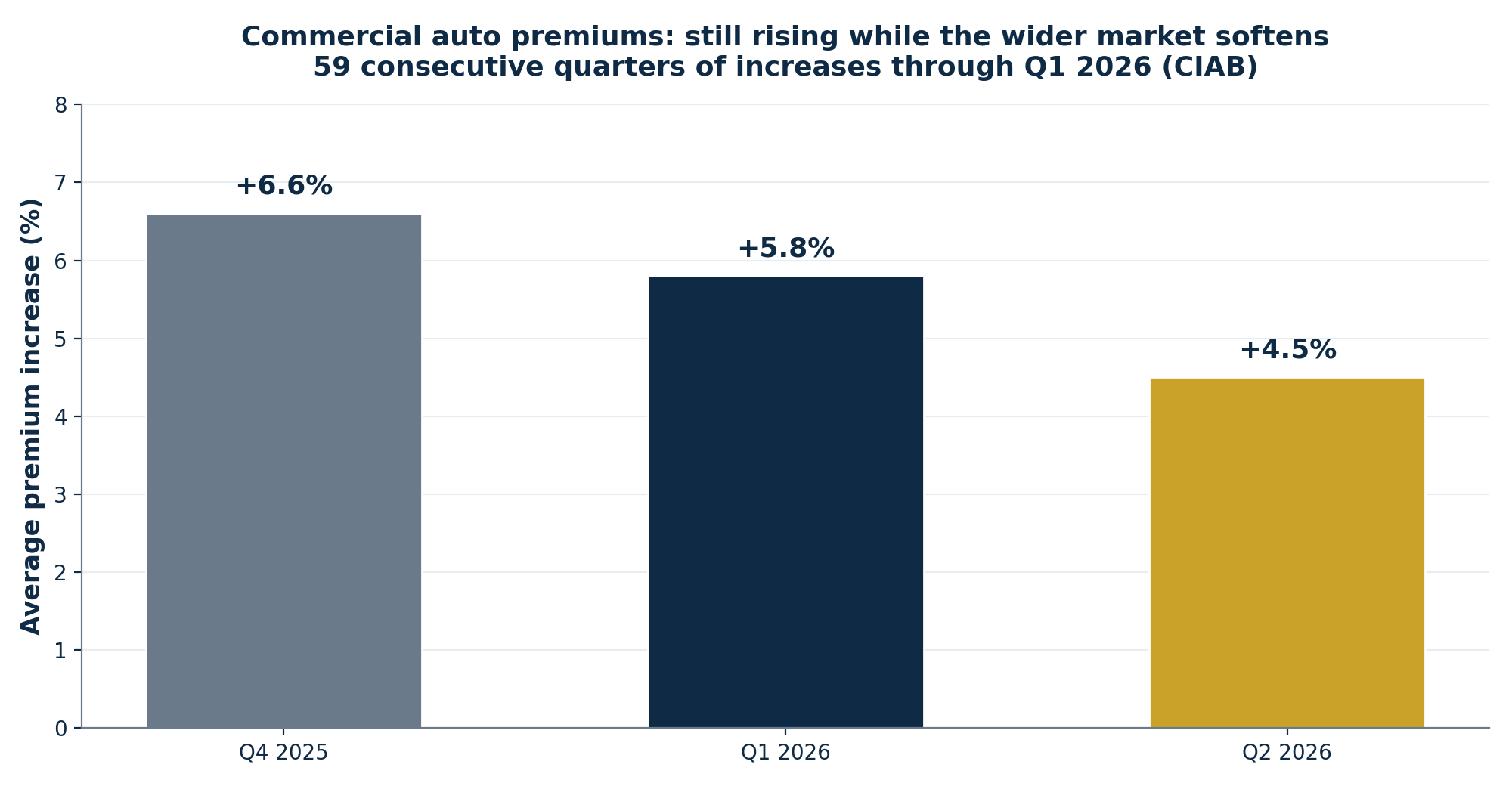
59 quarters.
That is how long commercial auto premiums have risen in a row, through the first quarter of 2026, in the Council of Insurance Agents and Brokers market survey. The increase that quarter was 5.8 percent, the largest of any major commercial line, in the same quarter the average commercial premium across all lines fell 1.2 percent for the first time since 2017. Auto is the line that did not get the soft market memo.
Most senior living operators hear that and think about the community van. The van matters. It is not the whole exposure, and for many operators it is not even the largest part of it. The larger part is every car the community does not own: the caregiver driving a resident to a specialist in her own sedan, the maintenance tech picking up a part in his pickup, the activities director renting a car for a conference, the nurse running a prescription back from the pharmacy. None of those vehicles is on your auto schedule. Every one of those trips can put your name on the lawsuit.
That coverage has a name, hired and non-owned auto, and it is usually the cheapest line in the program and the least examined. This article walks through how the liability actually attaches, what the driver’s personal policy really contributes, and the file an underwriter now wants to see before quoting it.
Every community runs a fleet it does not own
Start by counting trips, not vehicles. In a typical week, a single community generates work driving that never touches a titled vehicle:
- Resident trips to medical appointments, dialysis, and family events in a staff member’s car when the van is booked or down
- Pharmacy, lab, and supply runs, often by whoever is free, in whatever car is outside
- Bank deposits, post office runs, and trips between buildings in a portfolio
- Home visits, hospital follow ups, and family meetings by sales, clinical, and leadership staff
- Rental cars on business travel, and borrowed vehicles during a breakdown or a move in surge
The Network of Employers for Traffic Safety, in its 2026 update, puts the cost of motor vehicle crashes to U.S. employers at $62 billion a year in direct crash related expenses, covering medical care, liability, lost productivity, and property damage. Its average on-the-job crash costs the employer nearly $56,000, and that average includes the minor crashes. A serious injury crash is not an average crash.
If your risk register lists one van, it is missing most of your wheels.
The law does not ask whose car it was
The legal principle is old and simple. Under respondeat superior, an employer is liable for the negligence of an employee acting within the scope of employment. A court asks what the driver was doing and why, not who held the title. Picking up supplies, driving a resident, and making a delivery for the community are work, whether the car belongs to the community, the employee, or a rental counter.
Two consequences follow, and both surprise operators the first time a claim tests them.
First, you get named even when you did nothing else wrong. The community is the employer, it has the assets and the insurance program, and it will be in the caption. A separate claim for negligent entrustment, hiring, or supervision can follow if the file shows the driver should not have been driving at all.
Second, your general liability policy is not the backstop. Standard general liability forms exclude liability arising out of the ownership, maintenance, or use of an auto. If there is no auto coverage that reaches the trip, there may be no coverage at all for the community’s share, however good the rest of the program looks. This is general information about how these forms usually work, not legal advice. Your own policy controls your result.
The community does not need to own the car to own the claim.
The personal policy is a small first limit
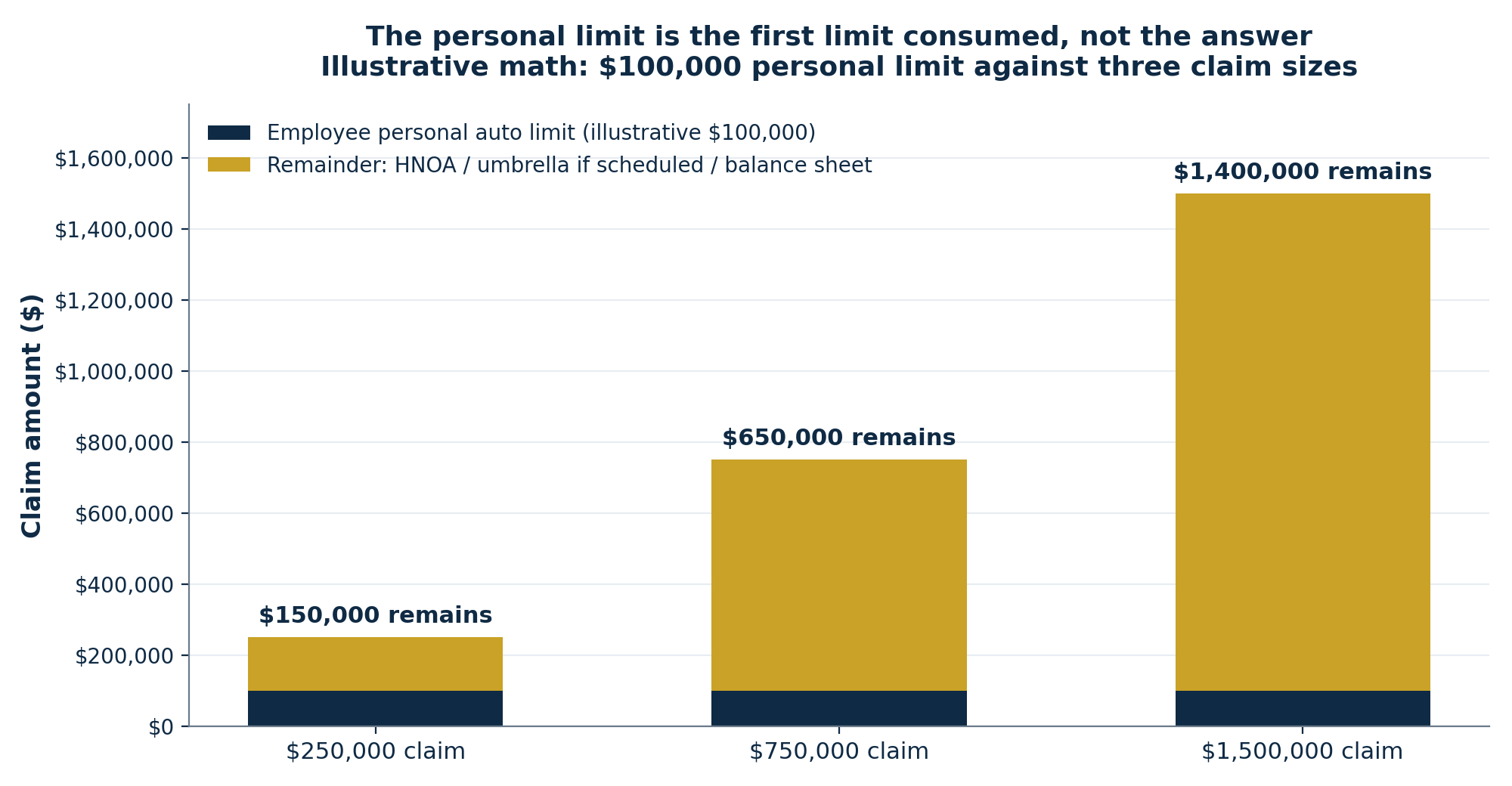
Here is the sequence operators get wrong. For a non-owned auto, meaning an employee’s own car, the driver’s personal auto policy is typically the first limit consumed, and the employer’s hired and non-owned coverage typically sits excess of it for the employer’s liability. Hired auto, meaning a rented or borrowed vehicle, works differently and can be primary for the business. The order varies by policy and state, so read your form. The structural point does not vary: the first limit in the stack is a personal limit you did not choose, on a policy you have never seen, that may be at or near a state minimum.
Run the arithmetic, labeled as arithmetic. The table assumes a $100,000 personal limit, a common requirement operators set when they set one at all, and it shows what is left for your hired and non-owned limit, your umbrella if it is scheduled to sit over it, and your balance sheet.
| If the claim is | The $100,000 personal limit covers | What remains above it |
|---|---|---|
| $250,000 | $100,000 | $150,000 |
| $750,000 | $100,000 | $650,000 |
| $1,500,000 | $100,000 | $1,400,000 |
Three gaps hide inside that simple stack.
The limit may not exist at claim time. Personal policies lapse, get rewritten at lower limits, and get shared across every claim in the policy period. Unless you collect proof of insurance and set a minimum limit as a condition of driving for work, you are assuming the first layer.
Physical damage is not in the deal. Hired and non-owned auto is liability coverage for the business. It does not repair the employee’s car, and hired auto liability does not repair the rental. The rental counter’s damage waiver and your hired physical damage decision are separate choices, made in advance or paid for after.
The umbrella may not follow. An umbrella or excess policy only sits over the underlying lines scheduled on it. Echo’s Fall 2026 market update flagged hired and non-owned auto as a growing concern for excess carriers, which is a polite way of saying they are now asking whether it exists, what limit it carries, and what driver controls sit behind it before they agree to sit over it. Verify the schedule. Do not assume it.
Echo has seen the uncovered version of this claim up close. Our published case work documents a $162,000 outcome on a hired and non-owned auto coverage gap, with the client name withheld for confidentiality. The gap, not the accident, is what made that file expensive to fix.
Why auto is the line that did not soften
The pricing is not a mystery, and it is not mainly about how often crashes happen. It is about what one crash now costs.
AM Best, as reported in trade coverage, recorded a net underwriting loss for commercial auto for the 15th consecutive year in 2025, about $1.9 billion, improved from about $4.9 billion in 2024. A joint study by the Insurance Information Institute and the Casualty Actuarial Society found that claim severity in commercial auto liability rose 78 percent from 2014 to 2023, an average of 6.6 percent a year, more than double the 29 percent rise in consumer prices over the same period. Carriers have raised price for almost fifteen years and still lost money on the line. That is why the streak survived the softening everywhere else.
Senior living sits on the harder end of that line. The 2027 marketplace forecast, as reported in October 2026, puts senior living auto liability increases at 8 percent to 15 percent for next year, and says carriers expect larger increases for smaller fleets and for hired and non-owned auto exposures as they account for increased claim severity. Echo’s own Fall 2026 read put senior living auto at 10 percent to 20 percent, with resident transport a specific underwriting focus. Either range leads to the same instruction: the operators who control this line are the ones who can document driver lists, motor vehicle record criteria, and driver training, because those documents are what open doors with new markets.
The passenger changes the claim
A resident in the car changes both the duty and the damages. The passenger is a frail older adult who trusted the community to get her to an appointment safely, and a jury will hear the case that way.
The background risk is real. NHTSA reports that 8,019 people age 65 and older were killed in traffic crashes in 2024, 20 percent of all traffic fatalities, with an estimated 284,525 older people injured. Distraction is the preventable part of that picture an operator can actually govern: NHTSA counted 3,208 people killed and an estimated 315,167 injured in distraction affected crashes in 2024 alone.
That is why the phone rule for anyone driving a resident, in any car, on any trip, is an insurance control and not just a safety poster. No handheld phone use while driving for the community, written down, trained, and enforced, belongs in the same file as the motor vehicle record check. If a crash happens and the phone records become the story, the rest of the file will not save the narrative.

What underwriters now ask for
The submission that prices well on this line is a driver file, not a vehicle list. Build it once and keep it current:
- A named driver list for every kind of trip. Titled vehicles, personal cars used for work, and rentals. If a person is not on the list, that person does not drive for the community.
- Motor vehicle records on a schedule, with written criteria. Annual checks at minimum, with clear disqualifiers and a documented review. A bad record found by a plaintiff’s expert that your file never looked for is the negligent supervision claim, gift wrapped.
- A minimum personal limit, verified. Require every employee who drives her own car for work to carry a stated minimum, collect the declarations page at hire and at renewal, and calendar the expirations.
- Documented driver training and a phone policy. Short, dated, and signed. Road testing or training for anyone who transports residents, in the van or in a car.
- Trip rules in writing. Who may transport a resident in a personal car, when the van is required instead, what happens after any incident, and who reports it the same day.
- Volunteers counted, not assumed. Volunteers are not employees, and coverage for a volunteer’s driving varies by form. Name the exposure to your broker instead of discovering the answer in a claim.
The 30 minute audit before you bind
You do not need a fleet department to close this gap. You need the auto policy, the umbrella schedule, and 30 minutes.
- Find the coverage symbols and the limit. Confirm hired and non-owned auto is actually on the policy, at what limit, and whether that limit is shared with your owned autos.
- Check the umbrella schedule. Confirm hired and non-owned auto is a scheduled underlying line. If it is not, the tower you think you bought does not sit over your most likely auto claim.
- List last month’s real trips. Pull them from mileage logs, pharmacy runs, and appointment schedules. Compare the drivers who actually drove with the driver list on file.
- Verify three personal declarations pages at random. If any one is below your minimum or expired, the control is a policy on paper only, and an underwriter will price it that way.
- Read the rental habit. Who rents, in whose name, and is the damage waiver bought or declined by rule? Put the rule in writing.
- Run the table above with your real stack. Personal limit, hired and non-owned limit, umbrella if scheduled. Use a $750,000 claim as the test. If the remainder reaches your balance sheet, the structure is wrong, and it is cheaper to fix now than after a resident is hurt in a car you do not own.
The van in the lot is the visible part of your auto exposure. The errand is the rest of it. Price it, schedule the umbrella over it, and build the driver file before renewal, while those choices are still yours to make.
Sources: Council of Insurance Agents and Brokers, Q1 2026 Commercial Property and Casualty Market Survey, as reported May 13, 2026 (commercial auto premiums up 5.8 percent, 59th consecutive quarter of increases; average premiums across all account sizes down 1.2 percent, first decline since Q3 2017; commercial auto up 4.5 percent in Q2 2026); AM Best commercial auto results and the Insurance Information Institute and Casualty Actuarial Society severity study, as reported in trade coverage (net underwriting loss for the 15th consecutive year in 2025 at about $1.9 billion, improved from about $4.9 billion in 2024; commercial auto liability claim severity up 78 percent from 2014 to 2023, 6.6 percent a year, against a 29 percent rise in the Consumer Price Index); 2027 Insurance Marketplace Realities senior living findings, as reported by McKnight’s Senior Living, October 2026 (senior living auto liability up 8 percent to 15 percent forecast, larger increases for smaller fleets and hired and non-owned auto exposures, annual motor vehicle record checks, strict driver criteria, and fleet safety protocols); Echo Assurance, Fall 2026 Senior Living Insurance Update, October 2026 (auto liability forecast at 10 percent to 20 percent, hired and non-owned auto becoming an excess carrier concern, resident transport underwriting focus on driver lists, motor vehicle record criteria, and documented driver training; hired and non-owned auto coverage gap case with a $162,000 documented outcome, client name withheld); Network of Employers for Traffic Safety, Costs of Motor Vehicle Crashes to Employers, 2026 update (crashes cost U.S. employers $62 billion a year in direct crash related expenses; average on-the-job crash costs employers nearly $56,000); National Highway Traffic Safety Administration, Distracted Driving in 2024, DOT HS 813 790, April 2026 (3,208 people killed and an estimated 315,167 injured in distraction affected crashes in 2024); National Highway Traffic Safety Administration, Older Population: 2024 Data, DOT HS 813 839, October 2026 (8,019 people age 65 and older killed in traffic crashes in 2024, 20 percent of all traffic fatalities, an estimated 284,525 older people injured).