Senior Living Insurance Brief: Week of November 16, 2026
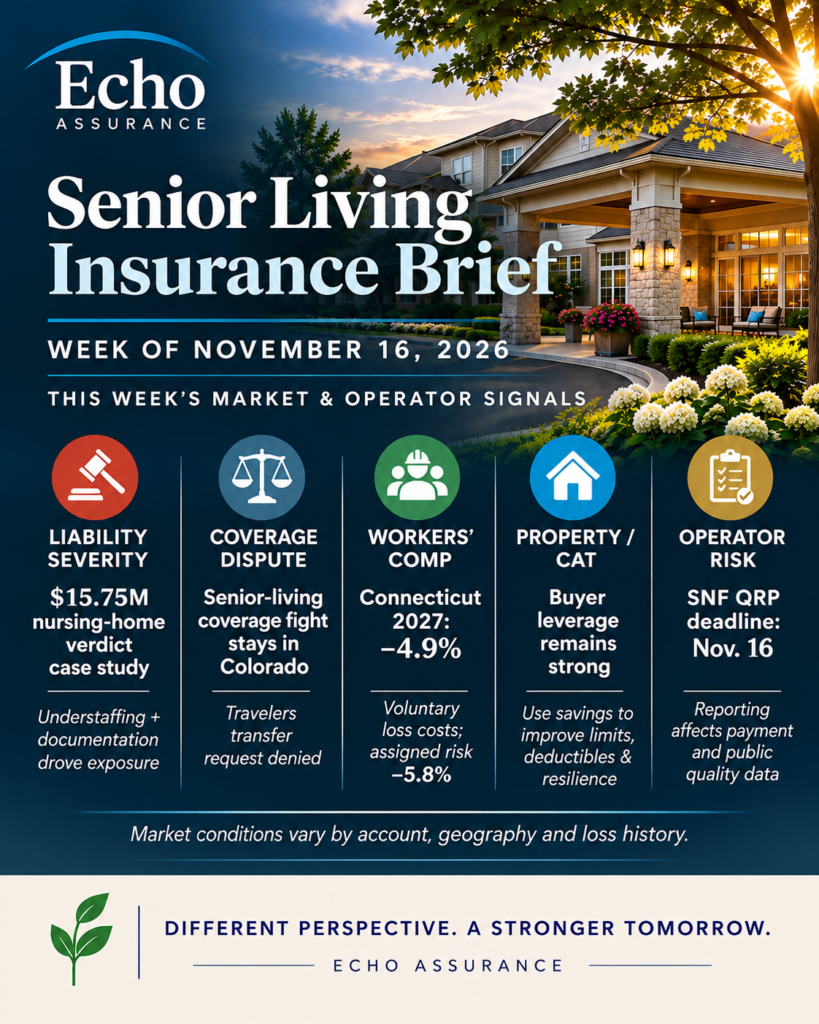
Senior living operators are getting more leverage from the insurance market, but liability severity is still capable of overwhelming those savings.
That is the clearest message this week.
A newly published nursing-home risk case study highlighted a $15.75 million verdict tied to allegations of chronic understaffing, pressure-ulcer care failures and inaccurate documentation.
The lesson is bigger than one claim.
When staffing decisions, clinical execution and documentation all point in the same direction, a routine professional liability claim can become an enterprise-level event.
There were several other developments worth watching:
Workers’ compensation: Connecticut approved a 4.9% reduction in voluntary-market loss costs for 2027 and a 5.8% reduction in assigned-risk rates. That continues the broader trend of workers’ compensation being one of the more favorable lines for many operators.
Property: Buyer leverage remains strong. Capacity and competition continue to create opportunities to improve limits, deductibles and coverage, not simply reduce premium. Where property savings are available, operators should consider whether some of those dollars belong in higher liability limits or improved risk protection.
Coverage: A federal judge this week kept a senior living insurance coverage dispute between Spectrum Retirement Communities and Travelers in Colorado. It is procedural rather than a decision on coverage, but it is another reminder that policy wording, placement history and claim communications matter long before a coverage dispute reaches court.
Operator risk: Today is also the CMS deadline for Q2 Skilled Nursing Facility Quality Reporting Program data. Quality reporting is not merely a compliance exercise. It affects public quality information and can affect Medicare payment when reporting requirements are not met.
The practical takeaway:
Take advantage of the favorable parts of the insurance market, but do not confuse cheaper property insurance with lower overall risk.
The strongest senior living operators should be using today’s market to improve the entire risk structure while continuing to demonstrate strong staffing, clinical controls, documentation and claims management.