Assisted Living Insurance Cost Per Bed: The Real Math

$500 to $900.
That is the published range for liability insurance alone, per licensed bed, per year, for most assisted living communities in the United States.
It is the number operators ask for first. It is also the number most likely to wreck a budget, because it is routinely mistaken for the cost of the whole insurance program. It is not. It covers general liability and professional liability. Property, workers compensation, umbrella, auto, cyber, and management liability all sit on top of it.
Here is how to use the per bed number without being used by it.
What the published numbers actually say
Start with what is reported, from named sources, before any interpretation.
CarePro Insurance, the assisted living program placed through HUB International, publishes liability pricing of $500 to $750 per licensed bed per year for standard assisted living, and $600 to $900 per licensed bed for memory care. On its own math, a 50 bed standard community lands at $25,000 to $37,500 a year for general and professional liability combined, before any other line is added.
A second publisher, Pro Insurance Group, puts the core program at $500 to $1,800 per occupied bed per year, with memory care and prior claims pushing toward the high end. Note the two differences. That range covers more of the program, and it uses occupied beds, not licensed beds. Both choices move the number up.
Then there is the only regulator dataset in the picture. In July 2025, the Washington State Office of the Insurance Commissioner reported on liability insurance for adult family homes, the small residential settings licensed for up to six residents, or eight with approval. Across 14,746 policies written from January 2019 through September 2024, the average annual liability premium was $424 per bed. More than 80% of policies priced under $550 per bed. About 5% priced at $900 or more. The per bed average rose from $318 in 2019 to $473 in 2024.
Adult family homes are not 60 bed communities. Read that study as a floor and a shape, not a quote. The floor: even the smallest, simplest residential care risk in one state averages over $400 per bed for liability. The shape: a small minority of risks pay double the average, and the market prices them that way because it sees something specific in their risk.
The math on a real building
Apply the published ranges to a 60 bed community and the budget conversation changes.
| Setting | Liability per licensed bed | 50 beds, per year | 60 beds, per year |
|---|---|---|---|
| Standard assisted living | $500 to $750 | $25,000 to $37,500 | $30,000 to $45,000 |
| Memory care | $600 to $900 | $30,000 to $45,000 | $36,000 to $54,000 |
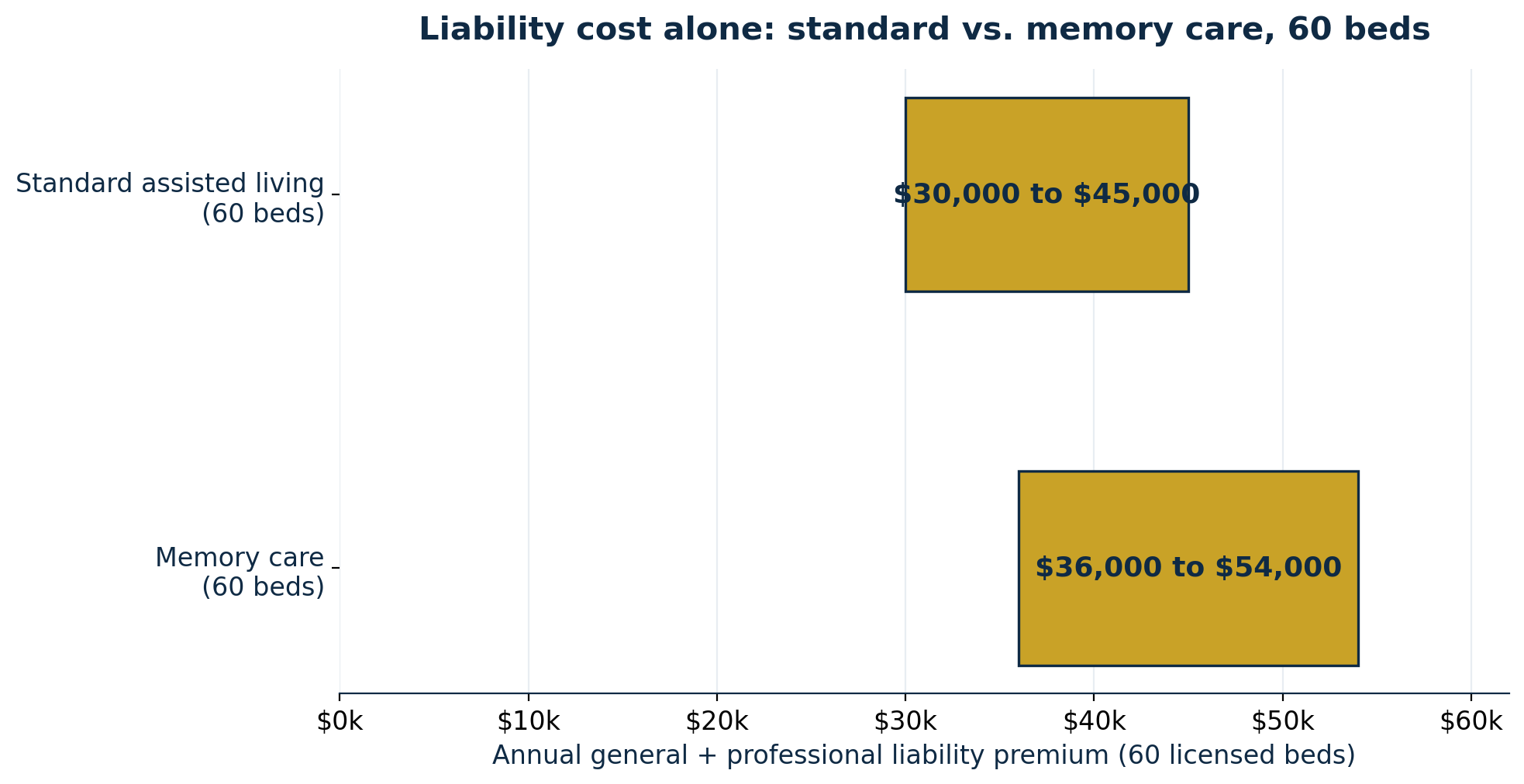
Two takeaways are arithmetic, not opinion.
First, memory care mix is a pricing decision. Moving a 60 bed building from standard assisted living pricing to memory care pricing adds roughly $6,000 to $9,000 a year in liability premium alone, at the same bed count, in the same building. Operators who convert units to memory care for the revenue and never reprice the insurance line are understating their own costs from day one.
Second, small per bed differences are not small. A $100 per bed gap sounds like a rounding error in a renewal meeting. On 60 beds it is $6,000 a year. On a ten community portfolio it is $60,000 a year, every year, compounding with rate. Negotiate per bed. Audit per bed. Argue about per bed. Just never budget on per bed alone.
Per bed is a useful yardstick and a dangerous budget. It tells you where you stand. It never tells you what you bought.
Licensed beds vs. occupied beds: the quiet distortion
Most liability pricing is quoted per licensed bed. Your revenue is earned per occupied bed. When occupancy slips, those two numbers pull apart, and your true cost per revenue producing bed rises even if your premium does not change by a dollar.
The arithmetic looks like this. It is illustrative, using round numbers on purpose. Take a total program premium of $108,000 for a 60 licensed bed community. At full occupancy, that is $1,800 per bed. At 90% occupancy, 54 residents, the same $108,000 is $2,000 per occupied bed. At 80% occupancy, 48 residents, it is $2,250 per occupied bed.
Same policy. Same premium. A $450 swing in real unit cost, driven entirely by census.
This is why two operators can pay the same per licensed bed and have completely different insurance economics. The fuller building spreads a fixed cost over more revenue. The emptier building carries it on fewer shoulders, at exactly the moment it can least afford to. When you benchmark against a peer, benchmark both denominators, or you are comparing a quote to a result.

What per bed leaves out
A per bed liability quote excludes most of what a bad year actually costs. Budget these lines separately, because each one prices on a different base.
Property: priced on the building, not the bed
Property premium follows replacement cost, construction, age, sprinklers, and catastrophe exposure, not census. An older building with a low per bed liability rate can still be your most expensive property risk. A per bed average hides that completely.
Workers compensation: priced on payroll
Comp follows payroll and your experience modification, not bed count. A community with stable, experienced staff and a credit mod can pay materially less than an identical building churning caregivers. Per bed comparisons that fold comp into one blended number erase the one line your management most directly controls.
Umbrella, auto, cyber, and management liability
Umbrella and excess layers sit above the primary liability limits, commonly starting from a $1 million per claim and $3 million aggregate baseline. Auto and hired and non owned auto price on vehicles, drivers, and transport activity. Cyber prices on records and controls. Directors and officers and employment practices price on governance and hiring risk. None of these scale cleanly with beds, and the transport line is moving fast: WTW forecasts senior living auto liability increases of 8% to 15% for next year.
The sublimit problem
Two quotes at the same per bed price can be different products. Abuse and molestation coverage is the classic case: included at full limits in one program, sublimited or excluded in another. Always compare what the per bed dollar bought, line by line, before you compare the dollars.
Where the number goes next
WTW, in its 2027 Insurance Marketplace Realities report as reported by McKnight’s Senior Living in October 2026, forecasts senior living professional liability rate increases of 5% to 15% for next year. Difficult litigation venues and developed losses sit above that range under closer underwriting. The same report puts property as mostly stable for senior care, with more scrutiny for facilities exposed to natural disaster, and notes umbrella and excess increases showing signs of peaking as more insurers enter that market.
Translate the forecast into one budget line. A 50 bed standard community paying $37,500 for liability today, the top of the published range, pays $39,375 at a 5% increase and $43,125 at 15%. That is $1,875 to $5,625 of new cost on one line, before payroll growth touches comp and before any change in your own loss history.
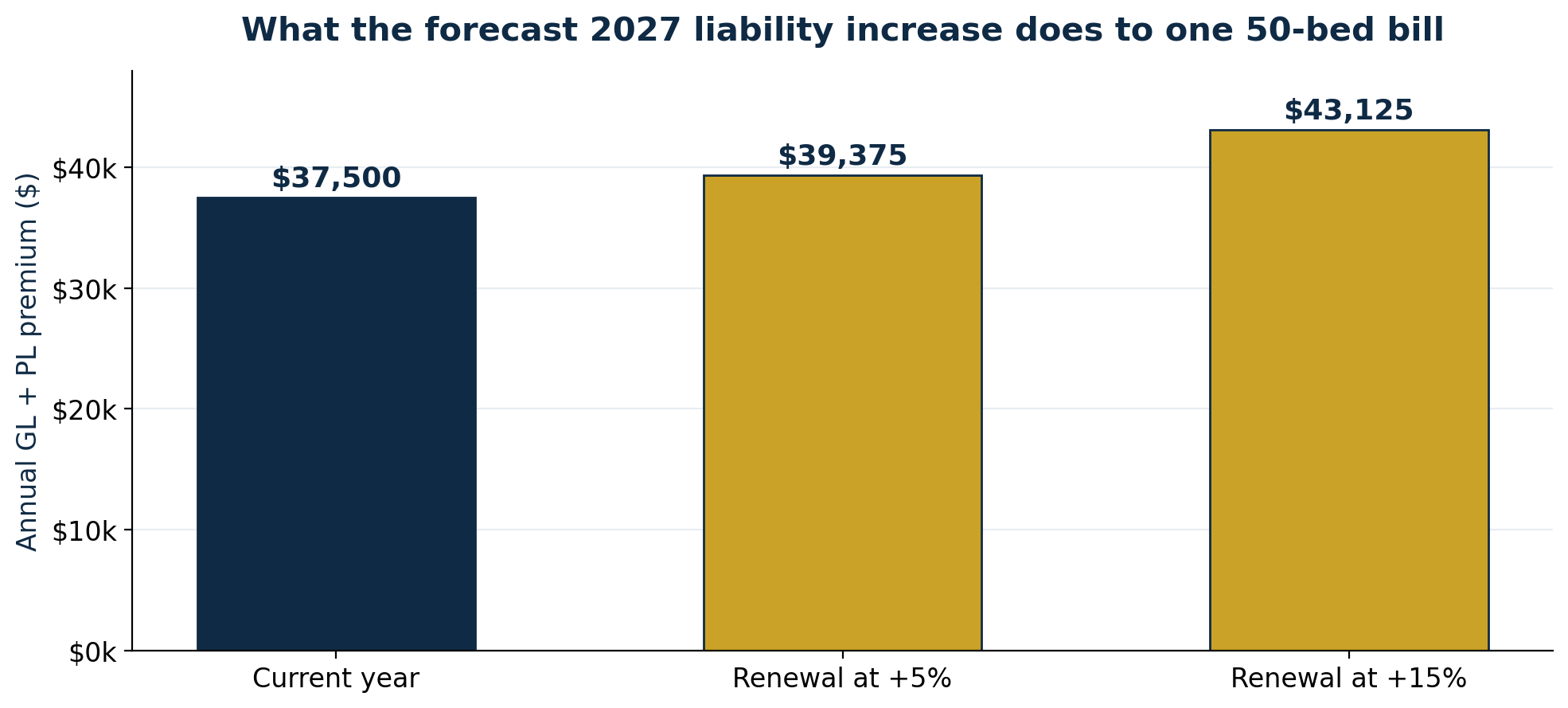
My read: budget the renewal at the top of the forecast range and treat anything better as found margin. Operators who budget at the bottom of a 5% to 15% range have not made a forecast. They have made a hope, and hopes do not survive underwriting.
How disciplined operators use the per bed number
- Normalize every quote to both denominators. Per licensed bed for market comparison, per occupied bed for your real unit economics. If a broker will only give you one, ask why.
- Unbundle before you compare. Liability, property, comp, umbrella, auto, cyber, and management liability each get their own line, their own base, and their own trend. Blended per bed quotes protect the seller, not the buyer.
- Check the sublimits behind the price. Abuse coverage, defense inside or outside limits, and claims made retroactive dates change what a claim costs you far more than $50 per bed changes your premium.
- Reprice every change in mix. Memory care conversions, higher acuity admissions, and new resident transport all change the risk the per bed rate was built on. Tell your broker before renewal, in writing, with the plan to manage it. Surprises price worse than changes.
- Bring the evidence file early. Incident trends, fall prevention, staffing stability, return to work results, and documented post incident reviews are what move an underwriter from the top of the range toward the bottom. Ninety days before renewal is the latest that file should exist. The per bed number you get is partly a price on your risk, and partly a price on how well you can prove it.
Per bed will always be the first number in the conversation. Make sure it is not the only one. The operators who know their cost per licensed bed, per occupied bed, and per line of coverage are the ones who negotiate renewals. Everyone else just receives them.
Sources: CarePro Insurance (HUB International), assisted living facility insurance cost guide, https://www.careproinsurance.com/assisted-living-facility-insurance ; Pro Insurance Group, assisted living facility risks and cost guide, https://www.proinsgrp.com/blog/7-risks-assisted-living-facilities-face-without-proper-insurance ; Washington State Office of the Insurance Commissioner, study on liability insurance for adult family homes, July 3, 2025, https://www.insurance.wa.gov/about-us/news/2025/study-liability-insurance-adult-family-homes-finds-market-reasonable-shape ; McKnight’s Senior Living, reporting on WTW 2027 Insurance Marketplace Realities, October 2026, https://www.mcknightsseniorliving.com/news/third-party-lawsuits-driving-senior-living-liability-rates-to-new-heights/