Captive Insurance for Senior Living Operators: When It Makes Sense, and What It Takes First

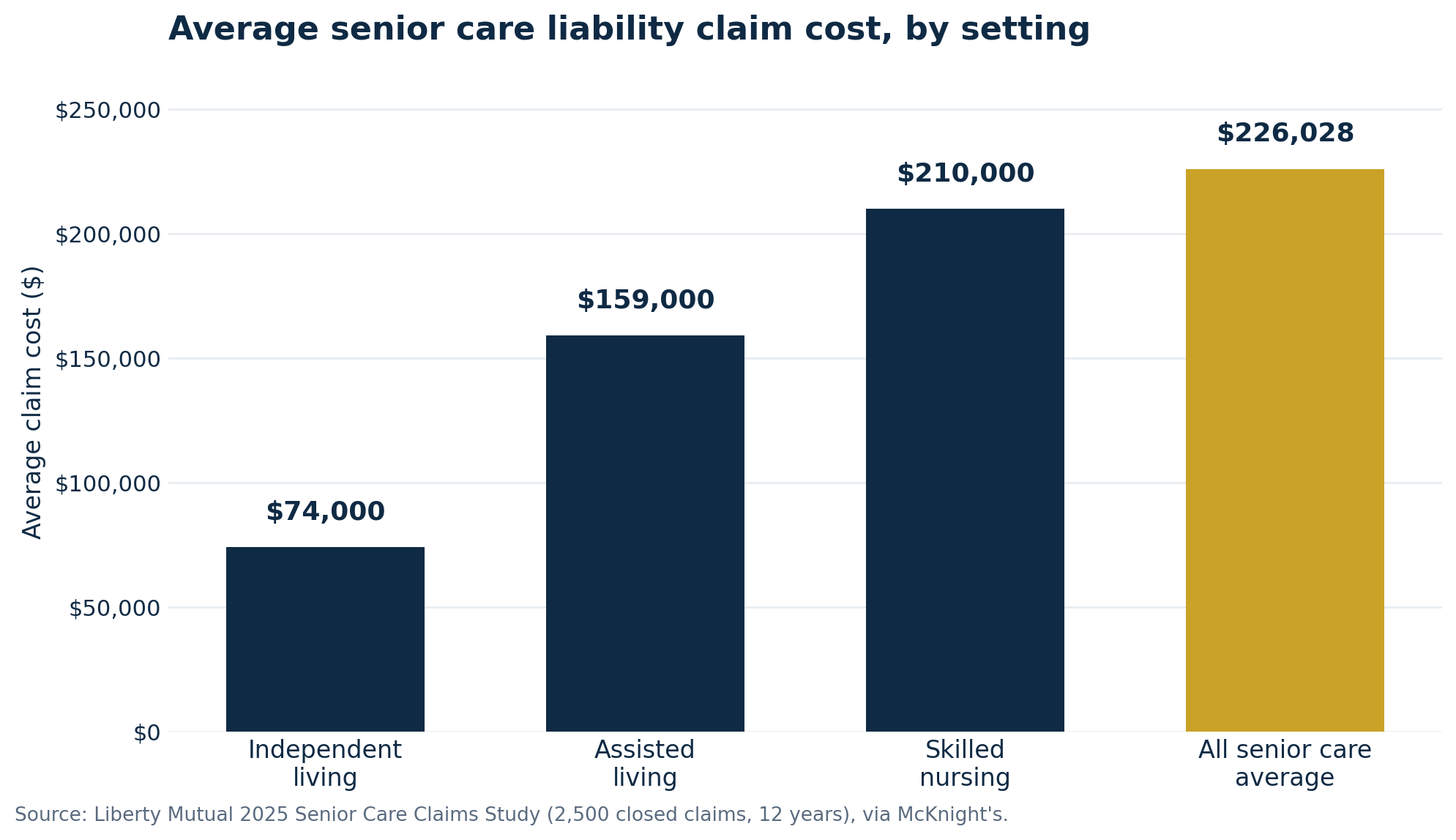
$226,028.
That is the average senior care liability claim payment in Liberty Mutual’s 2025 Senior Care Claims Study, which analyzed 2,500 closed claims over 12 years. The average doubled in the decade ending in 2024. Skilled nursing averaged $210,000 per incident. Assisted living averaged $159,000. Independent living averaged $74,000.
WTW forecasts senior living professional liability rates up another 5% to 15% next year.
So more operators are asking about captives. Most of them start with the wrong question. The first question is not what a captive costs, or what it saves. The first question is whether your own loss history is credible enough to price one. If it is not, a captive does not solve your insurance problem. It moves the problem onto your own balance sheet and hands you the bill.
This article walks through the three questions that decide the matter: when a captive makes sense, what underwriting credibility means before formation, and what formation actually requires.
What a captive is, and what it is not
In the NAIC’s plain definition, a captive is a wholly owned subsidiary created to provide insurance to its parent company. The insurer and the insured are owned by the same people. Premium that used to leave the building and never come back is paid instead to your own licensed insurance company, which holds reserves, pays claims, and keeps any underwriting profit that survives.
This is not a niche structure anymore. The NAIC counts roughly 8,000 captives worldwide, up from about 1,000 in 1980, spread across more than 70 domiciles. Vermont is the largest domicile in the United States. Marsh, in its 2025 Captive Benchmarking Report covering nearly 1,500 captives it manages, reported gross written premium up 6% in 2024 to $77 billion, with 92 new captives formed that year alone.
A captive is not three things operators sometimes hope it is.
It is not a discount. It is a decision to fund your own predictable losses yourself and buy protection only against the losses you cannot absorb.
It is not a tax strategy with an insurance wrapper. If a pitch leads with tax, walk away. A captive has to stand up as a real insurance company first: real risk transfer, real reserves, real claims, real regulation.
And it is not fast. Formation takes months of feasibility work, licensing, and capitalization before the first policy is written. Anyone promising you a captive by renewal has skipped the steps that make it work.
The pressure pushing operators toward captives
The commercial market is charging senior living for losses the sector does not fully control. In the Liberty Mutual study, falls drove 45% of all claims. Pressure injuries, abuse allegations, and elopements were less frequent and far more expensive per claim. Forty percent of closed claims carried a wrongful death allegation.
WTW’s 2027 Insurance Marketplace Realities report, as reported by McKnight’s Senior Living, puts claim costs rising faster than ordinary inflation, with third party litigation funding helping plaintiffs bring cases that once were too expensive to file. Carriers are responding the way carriers do: higher rates, closer underwriting, and less patience for operators who cannot document their risk.
That is the honest case for a captive. If your losses are genuinely better than the pool you are priced in, the commercial market keeps the difference. A captive is how a disciplined operator stops donating that difference.
When a captive makes sense: the five tests
Test 1: Scale
A captive carries fixed costs a commercial policy does not: a feasibility study, formation and legal work, a captive manager, an actuary, an auditor, and annual regulatory filings. Those costs only make sense spread over enough premium.
Feasibility guidelines commonly cited in the industry, including the guidance published by Captive International, put a single parent captive at roughly $1,500,000 or more in annual premium, group captive participation at roughly $500,000, and a rented cell structure as low as $250,000. Treat those as guidelines, not gates. The real test is arithmetic: if the fixed costs of running your captive eat the underwriting profit you hoped to keep, you do not have a captive strategy. You have an expensive hobby.
Test 2: Predictability
Captives work on the predictable layer of loss: the falls, the routine incidents, the claims that arrive every year in a fairly narrow band. They fail on volatility nobody priced. If your loss history swings because of one unexplained catastrophic claim after another, that is not a captive case. That is a risk management case, and it has to be solved first, in operations, before any structure will save you.
Test 3: A loss record better than your price
Run the simple math on your own program. If you pay $1,000,000 a year in casualty premium and your five year average loss ratio is 40%, about $400,000 a year has been paying claims and about $600,000 a year has been paying carrier expenses, profit, reinsurance, and the cost of carrier capital. A captive does not make that $600,000 free. It gives you the chance to earn part of it, after you pay your own manager, actuary, auditor, fronting fees, and reinsurance. Operators whose loss ratios run well below the market price for their peer group have something to capture. Operators at or above it do not.
Test 4: Capital, and patience
A captive needs capital on day one and surplus discipline every year after. The money funding the captive cannot be money the buildings need this winter. The payoff also takes time: reserves build, credibility in your own data builds, and the structure usually proves itself over three to five years, not three to five months. Boards that need a win this fiscal year should buy a better commercial program instead.
Test 5: Governance appetite
A captive is an insurance company. It has a board, minutes, audited financials, an annual actuarial opinion, and a regulator. Operators who run it like a bank account get the result that deserves. Operators who run it like an insurer, with underwriting discipline and claims discipline, get the result they wanted.
A captive does not fix a bad risk. It lets a disciplined operator keep the underwriting profit a carrier was keeping.

The three structures senior living operators actually use
| Structure | How it works | Who it usually fits | Scale and capital notes |
|---|---|---|---|
| Single parent (pure) captive | You own the insurer. It insures only your company and affiliates. Full control of underwriting, claims, and surplus. | Larger operators with the premium volume and the staff depth to govern an insurer. | Feasibility guides commonly cite $1,500,000 or more in annual premium. Vermont’s statutory minimum capital for a pure captive is $250,000, and the regulator can require more based on the risk written. |
| Group captive | Operators with similar risk profiles own the captive together and share results. | Mid size operators who want captive economics without carrying the whole structure alone. | Feasibility guides commonly cite about $500,000 in annual premium per member. One live senior living example: Marsh McLennan Agency’s Secure Harbor group captive writes general and professional liability up to $1 million per occurrence and $3 million in aggregate for members with similar risk profiles. |
| Protected cell (sponsored) captive | A sponsor owns the licensed core. You occupy a legally separate cell. Your assets and liabilities are ring fenced from other cells. | Operators who want a first step, or who are building the track record for a larger structure later. | Lower entry cost and faster setup, which Marsh also notes is driving cell growth. Vermont’s statutory minimum for the sponsored core is $100,000. Rented structures are cited as low as $250,000 in annual premium. |
The statutory minimums in that table are floors set by one domicile, not budgets. The capital your captive actually needs is set by the losses it retains, and any feasibility study that starts from the legal minimum instead of your loss data has the analysis backwards.
Underwriting credibility: the work before formation
Here is the problem nobody puts in the brochure. Most senior living operators have thin, lumpy loss data. A five community operator might see two serious claims in five years, or none, or five. No actuary can price that history on its own, and no regulator, fronting carrier, or reinsurer will accept a price built on hope.
Underwriting credibility is the answer to a specific question: how much can your own experience be trusted to predict your future losses?
Actuaries handle thin data by blending. Part of the price comes from your own loss experience. Part comes from industry benchmark data for operators like yours. Early on, the benchmark carries most of the weight, because your sample is small. As your volume and years of clean, consistently reported data grow, the weight shifts toward your own experience. That shift is earned. It is the whole game, and it is why the file you build before formation matters more than the entity you form.
I wrote about this problem at length in the May 2026 issue of Captive Insurance Company Reports, published by IRMI. That article is available to IRMI subscribers only, which is why this public explainer exists. The practical version of the argument is a credibility file with six components, assembled before anyone files a formation application.
1. Loss history an actuary can actually use
Five to ten years of loss runs, valued on a consistent basis, with every large claim explained in writing: what happened, what changed afterward, and whether that change held. Unexplained large claims do not get ignored in pricing. They get priced at the worst reasonable reading.
2. Losses separated by driver, not blended
Falls, pressure injuries, elopement, abuse allegations, and medication errors are different loss processes with different causes, different defenses, and different fixes. Blended into one average, they hide the one fixable problem driving your cost. Separated, they show an underwriter exactly where your risk is improving and where it is not. The Liberty Mutual data makes the point at sector level: falls are 45% of claims by count, while abuse and pressure injury claims carry the severity.
3. Exposure history that matches the losses
Losses without context are just bad luck stories. Beds, occupancy, resident acuity, staffing hours, and staff turnover, by building and by year, turn those stories into rates an actuary can test. If acuity rose and losses did not, that is evidence. If you cannot produce the exposure history, you cannot claim the credit.
4. Quality and staffing evidence, translated
Your quality systems already generate underwriting evidence: survey history, incident review discipline, staffing stability, and the corrective action record when something goes wrong. The work is translation. Show what the system found, what changed, when it changed, and what the results were after the change. Underwriters fund trajectories they can verify. They discount adjectives.
5. Claims discipline decided in advance
Who reports an incident, how fast, who documents, who sets reserves, who can authorize a settlement, and when outside counsel engages: all of it decided on paper before the first claim arrives. In a captive, slow reporting and soft documentation are no longer the carrier’s problem. They are your money, leaking.
6. A retention set by the bad year, not the average year
Price the layer you keep against a bad year, in writing, before formation. The table below is illustrative arithmetic on round numbers, using the published $159,000 average assisted living claim cost, to show what that test looks like.
| Illustrative retained layer: $1,000,000 premium program | Retained losses | What it proves |
|---|---|---|
| Expected year, at a 40% loss ratio | $400,000 | Pricing holds and surplus builds |
| Bad year: expected losses plus two average assisted living claims | $718,000 | Whether capital and reinsurance are sized honestly |
| Severe year: expected losses plus three average assisted living claims | $877,000 | Whether the board still believes in the structure |
If the severe year breaks the plan, the retention is too high, the capital is too low, or the operator is not ready. Better to learn that in a feasibility study than in year two, with a regulator reading the same numbers.
What formation actually requires
Once feasibility says go, formation is a sequence, and the sequence matters.
- Feasibility study. An independent actuarial and financial analysis of your losses, exposures, premium, capital capacity, and structure options, including the honest option of doing nothing. Captive International’s guidance puts single parent startup costs, covering feasibility, legal work, actuarial review, and tax opinions, typically starting at around $80,000.
- Structure and domicile selection. Single parent, group, or cell, domiciled where the regulator knows senior living risk. Vermont is the largest United States domicile, but it is not the only credible one, and the right answer depends on your footprint and your structure.
- Business plan and projections. The domicile regulator reviews a formal business plan: lines of coverage, limits, retentions, reinsurance, investment policy, governance, and multi year financial projections, including adverse scenarios.
- Capitalization and licensing. Capital goes in, in cash or approved instruments, at or above the statutory minimum and at the level your own risk requires. The regulator licenses the captive only when the plan, the people, and the money all hold together.
- Fronting and reinsurance, where needed. Lenders, contracts, and state rules often require policy paper from a licensed, admitted carrier. In a fronted program, that carrier issues the policy and your captive takes the retained risk behind it, for a fee, and the fronting carrier typically requires collateral against the risk you keep. Above your retention, reinsurance or excess coverage caps the catastrophic year.
- The operating team, then operation. A captive manager for day to day administration, an independent actuary, an auditor, claims administration, and a real board that meets, minutes its decisions, reviews loss development, and files what the domicile requires, every year.
Start this work well before the renewal you want it to affect. Feasibility alone should be finished while you still have time to fix the credibility file if it comes back thin. In my experience the operators who get the best result treat the first renewal inside the captive as the end of a two year project, not the start of a two month scramble.
When the answer is no, or not yet
Do not form a captive if your premium volume is too small to carry the fixed costs, if your losses are volatile and unexplained, if the capital belongs in staffing or in the buildings, or if the honest motive is a tax result rather than an insurance result. Do not join a group captive without reading how members share each other’s losses and what it costs to exit. And do not treat “not yet” as failure. A higher retention on a well structured commercial program, paired with two years of disciplined credibility building, is often the correct first move. It is also the move that makes the eventual captive cheaper to form and easier to defend.
The market is not going to price your risk for you fairly out of generosity. It prices the file it can read. Build the file first, and the structure, captive or commercial, will follow the evidence.
Sources: NAIC, Captive Insurance Companies (definition, global count of roughly 8,000 captives, more than 70 domiciles, Vermont as the largest United States domicile, captive classifications), https://content.naic.org/insurance-topics/captive-insurance-companies ; Marsh 2025 Captive Benchmarking Report, as reported by Captive.com (gross written premium up 6% in 2024 to $77 billion, 92 formations in 2024, nearly 1,500 captives covered), https://www.captive.com/news/marsh-2025-captive-report-captives-retain-more-risk-in-2024 ; Liberty Mutual 2025 Senior Care Claims Study, as reported by McKnight’s Long-Term Care News (2,500 closed claims over 12 years, average claim payment $226,028, skilled nursing $210,000 per incident, assisted living $159,000, independent living $74,000, falls 45% of claims, wrongful death allegations in 40% of closed claims), https://www.mcknights.com/news/senior-care-insurance-costs-double-over-a-decade-with-steepest-risks-for-snfs/ ; WTW 2027 Insurance Marketplace Realities, as reported by McKnight’s Senior Living (professional liability forecast up 5% to 15%, auto liability up 8% to 15%, claim costs rising faster than ordinary inflation, third party litigation funding), https://www.mcknightsseniorliving.com/news/third-party-lawsuits-driving-senior-living-liability-rates-to-new-heights/ ; Marsh McLennan Agency Secure Harbor group captive launch, as reported by McKnight’s Senior Living (general and professional liability up to $1 million per occurrence and $3 million in aggregate for members with similar risk profiles), https://www.mcknightsseniorliving.com/news/marsh-mclennan-launches-new-insurance-company-for-senior-living-and-care/ ; Vermont captive insurance statute, 8 V.S.A. section 6004 (minimum capital and surplus: pure captive $250,000, association captive $500,000, sponsored captive $100,000), https://legislature.vermont.gov/statutes/fullchapter/08/141 ; Captive International, captive feasibility guidance (premium volume guidelines of about $1,500,000 for a single parent captive, $500,000 for group participation, $250,000 for a rented structure, and single parent startup costs typically starting at around $80,000), https://www.captiveinternational.com/services/feasibility-studies/is-a-captive-right-for-you