Abuse and Molestation Coverage in Senior Living: The Sublimit Trap

$227,000.
That is the average cost of a failure to protect from abuse claim in assisted living, in a study of 2,500 closed senior care claims. In skilled nursing the same allegation averaged $286,000. In independent living it averaged $568,000.
Now look at the limit many operators actually carry for that claim. Not the $1 million on the declarations page. The sublimit buried in an endorsement, which in many package policies sits between $100,000 and $500,000.
The most severe claim in the building often carries the smallest limit in the policy. That is not a market rumor. It is how the standard policy is built, and this article walks through the form, the claim data, and the math.
The exclusion comes first
Start with what a standard general liability policy does not cover.
Most general liability policies in this sector carry ISO form CG 21 46, the Abuse or Molestation Exclusion. Read the form itself, not a summary of it. The insurance does not apply to bodily injury, property damage, or personal and advertising injury arising out of two things.
First, the actual or threatened abuse or molestation by anyone of any person while in the care, custody, or control of any insured.
Second, the negligent employment, investigation, supervision, reporting, or retention of a person for whom any insured is or ever was legally responsible, when that person’s conduct would be excluded under the first part.
Two words in that form decide most real claims.
The first word is anyone. The exclusion is not limited to an employee. A claim involving another resident, a contractor, or a visitor can still fall inside it.
The second is negligent. The claim a family actually brings against an operator is rarely that the operator committed the abuse. It is that the operator hired carelessly, supervised loosely, investigated slowly, or kept someone on staff after a warning sign. The form excludes that claim too, by name: employment, investigation, supervision, reporting, retention.
So abuse coverage does not exist in a senior living program unless it is bought back on purpose, by endorsement or as a standalone policy, and unless the buyback covers both the act and the negligent supervision claim that follows it. If your program review has never produced the actual endorsement, you do not know which of those two you own.
What the claims actually cost
Reported facts, separated from our analysis.
A 2025 senior care claims study analyzed 2,500 closed claims resolved over the past 12 years. The overall average claim rose to $226,028 by the end of 2024, double the level of a decade earlier. Falls drove volume, at 45 percent of all claims. Abuse, pressure injuries, and elopements were less frequent and more expensive.
On failure to protect residents from abuse, the study found the highest costs of any allegation it tracked: an average of $227,000 across 23 assisted living claims, $286,000 across 28 skilled nursing claims, and $568,000 across four independent living claims. For context, the average claim of any kind in assisted living in the same study was $159,000.
A separate analysis of more than 2,000 claims, reported in October 2026, put the average indemnity payment on senior care claims at $253,000 in 2024, up from $179,000 in 2019. Memory care cases in assisted living averaged $233,000, almost 23 percent higher than assisted living cases with no memory care exposure. A carrier executive quoted in the same reporting said claims that once settled near $175,000 are now reaching up to $500,000.
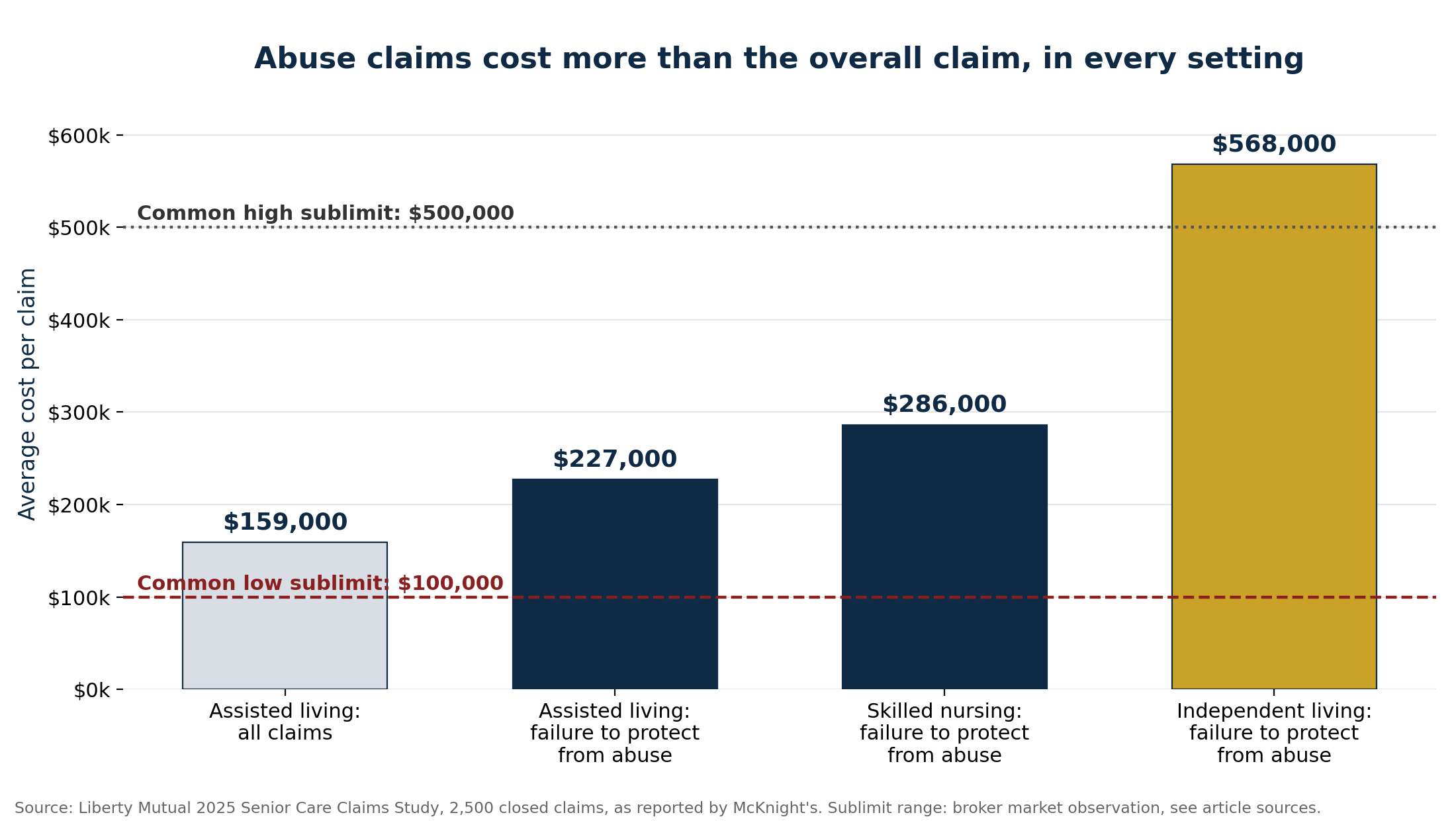
Read the independent living number carefully. Four claims is a small sample, and one large result can move an average. Do not budget off $568,000. Do notice the direction: a setting families think of as low acuity produced the highest abuse average in the study, because the allegation is judged on perceived preventability, not on how much care the resident was buying. The study made that point directly. Abuse and elopement claims are viewed through a lens of perceived preventability, especially with vulnerable residents.
The most severe claim in the building is often the one with the smallest limit in the policy.
The gap, in dollars
Here is the arithmetic an operator should run before renewal, not after a claim. The table is illustrative. It assumes a claim resolves at the reported average, and that the sublimit shown is the only limit available for that claim. Your form controls your result, including whether defense costs sit inside or outside the limit, which changes how fast a limit erodes.
| If an abuse claim resolves at | A $100,000 sublimit leaves you | A $250,000 sublimit leaves you | A $500,000 sublimit leaves you | A full $1,000,000 primary limit leaves you |
|---|---|---|---|---|
| $227,000 (assisted living average) | $127,000 | $0 | $0 | $0 |
| $286,000 (skilled nursing average) | $186,000 | $36,000 | $0 | $0 |
| $500,000 (upper end now reported on claims that once settled near $175,000) | $400,000 | $250,000 | $0 | $0 |
| $568,000 (independent living average, small sample) | $468,000 | $318,000 | $68,000 | $0 |
Three more questions decide whether even this table is optimistic.
Is the sublimit per claim, per victim, or a single aggregate? If one incident involves more than one resident, or a second allegation arrives in the same policy year, an aggregate sublimit can already be spent. A limit that looks adequate for one claim may be the whole year’s coverage.
Do defense costs erode it? An abuse allegation has to be defended even when it is unfounded, and defense is not cheap. If defense sits inside a $100,000 sublimit, the amount left to settle a claim is whatever the lawyers did not use. Ask for the answer in writing, from the form.
Does the claim get reported in time? Most senior living liability today is written on claims made forms. An incident that staff knew about and nobody reported can become a coverage fight before it becomes a settlement discussion. Incident reporting discipline is coverage, in the practical sense: no report, no claim, no defense.

The tower problem: excess does not automatically fix it
The common answer to a low sublimit is, we have excess. Check that answer against your own tower.
A wholesale broker quoted in October 2026 trade reporting put the trap plainly: an operator can think abuse coverage is included in the excess, but because abuse is sublimited on the primary and sublimits are excluded on the excess, the operator does not have abuse cover going all the way up.
That happens in two ways. Some excess and umbrella forms carry their own abuse exclusion. Others follow the primary form, which sounds reassuring until you realize following the form can mean following the sublimit: the excess attaches above the sublimit that applied, not above the full $1 million primary limit the declarations page advertises.
Excess pricing makes this worth checking now, not later. The same October 2026 reporting found excess and umbrella increases reaching 30 percent or more on some programs, with individual excess limits that were once $10 million to $15 million now generally reduced to about $5 million. Operators are paying more for towers that may still stop at $100,000 on the one allegation with the highest average cost. Paying more for a tower is only rational if you know which claims actually travel up it.
What underwriters want before they raise a sublimit
A higher abuse limit is not only a purchase. It is an underwriting decision, and the file decides it. The claims study above pointed carriers and operators to the same controls: regular staff training on abuse policies, safety protocols, and de-escalation, plus thorough pre-employment screening.
In practical terms, the file that supports a real limit usually shows:
- Screening that can be proved: background checks and reference checks completed before start dates, with the records filed, not described.
- Training that can be proved: abuse recognition, reporting duties, and de-escalation, by employee and by date, refreshed on a schedule.
- Supervision that can be proved: staffing records matched to acuity, and a clear rule for one on one care situations.
- Reporting that can be proved: an incident log where every allegation, founded or not, is recorded, escalated, and reported to the carrier promptly.
- Investigation that can be proved: who investigated, what was found, what changed, and when. Remember, negligent investigation is one of the exact claims the exclusion names.
None of that guarantees a higher limit or a lower price. It does change the conversation from a hope to a file. Underwriters raise limits on risks they can defend internally, and a documented prevention file is defensible. An assurance that the team is careful is not.
The 30 minute audit before you bind
You do not need a consultant to find this gap. You need the policy and 30 minutes.
- Find CG 21 46, or its equivalent, in your forms schedule. If an abuse exclusion is attached, assume there is no abuse coverage until a buyback is produced.
- Produce the buyback. Endorsement or standalone policy, in hand. Note whether it covers resident on resident conduct, contractors, and negligent hiring, supervision, investigation, and retention, not only an employee’s act.
- Write down four numbers: the sublimit, whether it is per claim or aggregate, whether defense is inside or outside it, and the retention that applies to an abuse claim specifically.
- Run the table above with your numbers. Use $227,000 and $500,000 as the two test claims. If the remainder is a number your balance sheet cannot absorb without pain, the limit is wrong.
- Read the excess form for abuse. Look for its own exclusion, and for language that excludes or follows primary sublimits. Get the answer from the form, not from a proposal summary.
- Price the fix three ways: a higher sublimit on the current program, a standalone abuse policy, and a program built by a carrier that writes abuse at full primary limits. Compare them on the remainder in step 4, not on premium alone.
- Fix the reporting rule the same week. Every allegation, every incident that could become one, reported internally the same day and to the carrier promptly. Put the rule in writing and train to it.
A $1 million limit on the declarations page feels like a finished program. On an abuse claim, the program is whatever the sublimit, the aggregate, the defense treatment, and the excess form say it is. Those four items fit on one page. Most operators have never seen that page assembled.
Pull it before renewal. The claim will not wait for you to pull it after.
Sources: Liberty Mutual 2025 Senior Care Claims Study, as reported by McKnight’s Long-Term Care News (2,500 closed claims resolved over the past 12 years; overall average claim $226,028 by the end of 2024; assisted living average $159,000 per incident; falls 45 percent of claims; failure to protect from abuse averages of $227,000 in assisted living on 23 claims, $286,000 in skilled nursing on 28 claims, and $568,000 in independent living on four claims); MedPro Group analysis and market reporting, Business Insurance, October 2026 (average indemnity $253,000 in 2024, up from $179,000 in 2019, on more than 2,000 claims; memory care assisted living $233,000, almost 23 percent higher than assisted living with no memory care exposure; claims once settling near $175,000 now reaching up to $500,000; excess and umbrella increases reaching 30 percent or more; individual excess limits generally reduced from $10 million to $15 million to about $5 million; wholesale broker warning that excess cover may not follow a primary abuse sublimit up the tower); ISO form CG 21 46 07 98, Abuse or Molestation Exclusion (actual or threatened abuse or molestation by anyone of any person while in the care, custody, or control of any insured, and negligent employment, investigation, supervision, reporting, or retention); Broker market observation on buyback practice (many packages add back a sublimit of $100,000 to $500,000 against a $1 million liability limit, and umbrella forms may carry their own abuse exclusion or attach above the sublimit), Pro Insurance Group, Senior Living Facility Insurance and What Does Assisted Living Insurance Cover and Exclude